Showing posts with label dentist. Show all posts

Monday, February 2, 2015

Smile Designing -Part 1

What is Smile Designing?


A smile is one of your most noticeable features. A cheerful face makes you instantly more attractive and approachable. 


But what if you are self-conscious about your teeth or gums? 

Many people cover their mouths or do not smile fully for fear of showing features in their mouth that they do not like. 

Do you long to have a smile you are proud to show the world? 

This is where smile designing comes into play.


Smile Designing is the process of pre-visualizing the ideal smile and planning to predictably achieve the desired end result. 


In the past, dentists tended to deal with different problems in the mouth separately. Smile Designing is a comprehensive approach, taking into consideration the way the mouth is used in eating and speaking, as well as smiling. All the factors which contribute to your smile are evaluated -this includes not just your teeth and gums but also your lips, bones, muscles and skin. 

The aim is to create a balanced and harmonious smile which looks natural. The end result should match the facial features, personality and age of the individual. With careful planning and good maintenance the result will also be long lasting. 

It is important to find a dentist with the right training and experience in Smile Designing. To achieve the desired result a cosmetic dentist may need to work closely with other specialists such as orthodontists, periodontists and implantologists and oral surgeons. A great lab technician who uses the best materials is also vital.


At Smile Station in Bangalore Dr. Gurudev and his team use their training and expertise to give their clients smiles which they are proud to show to the world. 


In the following parts of this blog we will discuss the planning process and some of the techniques used in Smile Designing. 


Friday, November 7, 2014

Sensitive Teeth?

Why are my teeth sensitive?

Are your teeth sensitive?
Do you avoid cold food and drinks?
How do you know if it’s just sensitivity or a more serious problem?


How common is sensitivity?

It is very common to experience some pain with extremely cold food and drinks. Teeth may also be sensitive to sweet, acidic or hot food and drinks. It is more common in young adults and women report more sensitivity than men. More often dental sensitivity is mild but for some people it can have a significant impact on their daily life.


What causes tooth sensitivity? 


The most common cause of sensitive teeth is exposure of the dentine layer of the tooth. In comparison to the outer enamel layer of the tooth, which is the hardest tissue in the human body, dentine is softer and more porous. Changes in temperature or pressure cause movement of fluid within dentine and this stimulates pain receptors, causing sensitivity.


How does dentine become exposed?

In a normal, healthy tooth dentine is covered by enamel above the gum level and cementum on the root surface. The most common cause of dentine exposure is gum recession leading to exposure of the root surface. The cementum layer on the root surface is softer and thinner than dentine and is prone to wear away leaving the dentine exposed.


What causes gum recession?


  • The most common cause is gum disease caused by plaque build-up due to inadequate brushing and flossing.


  •  Brushing too aggressively with a wrong technique or a toothbrush that is too hard can wear down the enamel at the gum level as well as damage the gums. (For more information on brushing technique, click this link.)

  • Excessive clenching and grinding of the teeth can cause enamel at the neck of the tooth to become worn away and worsen pre-existing gum disease.

  • Using smokeless or chewing tobacco can lead to gum recession and more serious problems such as mouth cancer. Smoking also increases the risk of gum disease.

Dentine can also become exposed when enamel is worn away

This may be due to:

·         Long term tooth wear due to a heavy bite or tooth-grinding habit.

·         
     Frequent exposure of tooth enamel to acidic food and drinks.  

·         Stomach acid due to reflux or frequent vomiting.


·         Tooth decay


A cracked tooth of filling may also lead to sensitivity or pain.

Teeth may also be temporarily sensitive after placement of fillings or tooth whitening procedures.


How can I tell if sensitivity is a sign of a more serious problem?

It’s not always easy to tell. It’s always best to see your dentist if sensitivity is an issue so that they can investigate the cause and find the correct treatment.
If you experience pain for some time after the trigger has been removed, or if your teeth are sensitive to hot this is could be a sign of inflammation within the tooth pulp which contains the nerve.  This needs to be dealt with as soon as possible, to avoid losing the tooth.


How can sensitivity be treated?

This really depends on the cause. The following chart covers some of the most common causes:

Gum disease and recession
Improvement in brushing and flossing techniques.
Regular professional cleaning.
More complex periodontal treatment required for severe gum disease.

Tooth wear and toothbrush abrasion
Correct brushing technique using soft bristled brush.
Fluoride varnish.
Fillings or sealants may be required to replace lost tooth surface and protect exposed dentine.

Tooth grinding habit
Mouth guard can be made to be worn at night to prevent tooth grinding.

Acid erosion of tooth enamel
Change in diet, reducing consumption of acidic and sweet food and drinks.
Treatment of cause in case of reflux or vomiting.
Wait 20 minutes before brushing teeth after acid in mouth.
Fluoride gel or varnish.
Fillings, crowns or veneers may be required to replace lost tooth surface and protect exposed dentine.

Tooth decay
Fillings.
Root canal treatment may be required if decay is very deep and the nerve is infected.
Prevention of further decay.


How can I prevent tooth sensitivity at home?

Of course, if there are certain foods and drinks which trigger sensitivity, these are best avoided.

As mentioned above, good diet and oral hygiene will decrease your risk of dental decay and gum disease.

Fluoride helps to reduce sensitivity and decay, it can be found in toothpastes and mouthwashes.


Toothpastes made specifically for sensitive teeth also contain other mineral compounds which can help to numb the tooth nerve or create a protective barrier preventing stimuli, such as cold and heat, from causing pain sensations. You need to use these toothpastes regularly, twice a day. If particular teeth are sensitive, you can use your finger to rub a small amount of paste onto the sensitive tooth surface after brushing.

If you have any questions or concerns, please contact Smile Station (click for link), where we will be happy to help you.


Straight Front Teeth Fast!

Are you embarrassed about your smile?

Maybe you have crooked front teeth and have considered seeing an orthodontist but feel it is too late to wear braces as an adult?

Are you worried about the cost and length of treatment involved?


Thanks to a recent innovation in orthodontics, treatment may be easier, faster and less expensive than you expect.

The Inman Aligner uses 3D technology to safely straighten front teeth faster than other appliances.

How does the Inman Aligner work?


The appliance has nickel-titanium coil springs which power aligner bow wires which rest on the inner and outer aspects of the front teeth. This produces gentle forces which act over a long range of movement to guide the teeth into their new position. 


What does it look like?

The metal springs towards the back of your mouth may be visible when you smile. The part the brace on the front teeth is made from clear acrylic.

It looks much better than conventional "train-track type" braces but is slightly more noticeable than "invisible" braces which are completely clear.

The appliance can be removed for short periods of time for special occasions or taking photographs, as well as for daily cleaning.


What is the difference between the Inman Aligner and other types of braces?

Due its unique design, the Inman Aligner can safely straighten teeth faster than others appliances. Treatment is usually completed within 6-18 weeks.

"Invisible" aligners take at least 6 months and traditional fixed braces between 1 to 2 years to complete treatment. 

Faster results and fewer visits also means that treatment is less expensive.


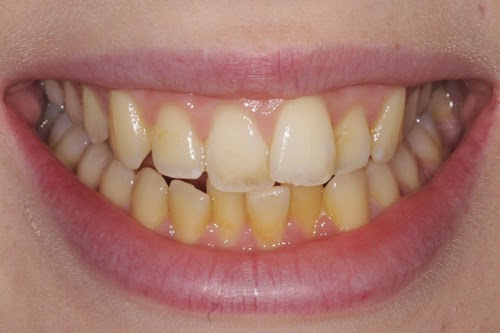
Before treatment
After treatment


Which problems are suitable for treatment with the Inman Aligner?


  • Mild to moderate crowding or protrusion of front teeth.
  • Rotated front teeth.
  • Cross bites - upper incisor teeth behind lower teeth in bite.
  • Where front teeth have become crooked after finishing traditional orthodontic treatment.
  • Pre-alignment of front teeth before cosmetic treatment, such as veneers or whitening. In fact, the Inman Aligner has been called the "missing link" between cosmetic dentistry and orthodontics.

Before treatment

After treatment


What is involved in the treatment?

  • The appliance is removable, but in order to get the fastest results it must be worn at least 20 hours per day. 
  • A mould of your teeth will be taken so that the appliance can be custom made in a dental laboratory.
  • As with all braces, there may be some discomfort and speech may be affected when the appliance is initially fitted, but this should only last for up to a few days.
  • You would need to see the dentist for checks every 2 or 3 weeks whilst wearing the appliance.
  • After any orthodontic treatment, a retainer is advised to prevent the teeth moving back. This could either be a removable retainer, or a thin wire bonded to the backs of the teeth (where it cannot be seen).


Find a certified user


It is important to find an dentist who is trained and certified in using the Inman Aligner and uses genuine appliances. 

If you are in Bangalore, you are welcome to visit us at Smile Station in Indiranagar and discuss if the Inman Aligner may be the right solution for you.

Tuesday, April 15, 2014

Overcoming Dental Anxiety - Part 4

In this blog so far, we have discussed causes of dental fear and anxiety and ways to overcome them. 

In this concluding section we will look at some more issues, in particular the importance of good pain control and techniques for relaxation.

Fear of being awake for treatment


One major difference between dentistry and other medical specialties is that, most of the time, patients remain awake for treatment. Many patients with a dental phobia say that they would like to be "knocked out" (have a general anaesthetic) for treatment but there are reasons why a general anaesthetic (GA) is not used routinely, but only as a last resort, in dentistry. There are risks associated with having a GA and it is required that general anaesthetics are only carried out in a fully equipped hospital. Weighing the risks against the benefits, GA is generally only justified for complex oral surgery or for urgent treatment when other methods, eg. psychological techniques and sedation, have been tried unsuccessfully. In addition, having treatment while asleep will not help a person with dental phobia overcome their fears and it will not be possible to keep having treatment under GA in the future. It is much better to find a good, sympathetic dentist who will work with you as we have discussed in part 2 of this blog.


Fear of "the drill"


For many people, even the sound of the dental handpiece (or drill) can make them very anxious. This may be due to a previous bad experience where the tooth was not sufficiently numb and/or the dentist did not stop treatment when they felt pain. 

When a tooth is properly numb, the only sensations that should be felt are vibration and slight pressure (see more about this in under subheading "fear of pain"). However, for some, the vibration itself can be uncomfortable. If this is the case, using an electric tooth brush at home may be help you get used to the vibration sensation. 

Many people do not like the sound of "the drill". Music can be helpful to blend out unpleasant sounds. Some dentists have music in the treatment room, or you could bring your own mobile device with your favourite songs or music for relaxation on. Of course, you would need to turn the music off when you need to speak to the dentist.

Other distractions, such as watching a video, either on a screen above the dental chair or by wearing virtual reality goggles, may also help. Sometimes it is helpful if your dentist tells you that they will need to use the handpiece for 5 or 10 seconds at time and even counts this out loud. Don't forget, you can let your dentist know that you need to take a break by raising your hand. This is called the "stop signal" which we discussed in part 3 of this blog


Fear of Pain


If you have had a past experience of painful treatment at the dentist this will have most likely have led to fear and anxiety. 

The reason for pain could have been:
  • Not having local anaesthetic (LA) to numb the tooth when it was required.
  • The dentist starting treatment without allowing sufficient time for the local anaesthetic to work - this can take between 5 and 15 minutes, depending on the tooth and procedure.
  • Infection in the tooth or surrounding area may prevent the LA working properly. This can sometimes be a problem during root canal treatment and antibiotics or a sedative dressing placed in the tooth between visits may be required.
  • Painful injection (see next paragraph).
  • The dentist not stopping when you felt pain to make you comfortable or give more local anaesthetic.
All of these problems can be overcome with a combination of good communication and using the right techniques. Don't be afraid to tell your dentist if you experience pain so that they can do something about it.

Fear of injections


Maybe when local anaesthetic injections were mentioned in the last paragraph, you thought "but that is my biggest fear!" This is quite common, to the extent that some people would rather suffer pain during treatment that have the numbing injection. Generally, the thought of having an injection is much worse than the reality and there are ways that your dentist can help you:
  • A good relationship with a dentist you can trust goes a long way in relieving anxiety.
  • A topical gel or spray can be used to numb the gum first, this takes a couple of minutes to work.
  • Injection should be slow and gentle - fast injection can cause pain.
  • Distraction - your dentist may talk to you or you may listen to music or watch a video.
  • Relaxation techniques (discussed below).
  • Try to think about the benefits of your tooth being numb so that you will not have pain during treatment.

Fear of choking or gagging


Some people have a strong gag reflex or have a fear of choking while at the dentist. There is a physical aspect to this but anxiety will also cause these problems to be worse. The following solutions may help:

  • Discuss the problem with your dentist so that they can find ways to help you.
  • Slow breathing through your nose. For those who have a problem with this, a nasal spray used beforehand may help.
  • Your dentist could use a numbing throat spray to make the area less sensitive. Some people also find rinsing with salty water or putting salt on the tip of their tongue has a similar effect.
  • Desensitization - you could ask your dentist if you can borrow a mouth mirror to practice placing it in your mouth at home.
  • Distraction or humming to yourself.
  • Relaxation techniques (discussed below).
  • Inhalation sedation using nitrous oxide mixed with oxygen (discussed below) is also known to reduce the gag reflex as well as anxiety.


Relaxation Techniques


Relaxation is the opposite of anxiety and it is impossible to be relaxed and anxious at the same time. There are various relaxation techniques that you can try to see which works best for you. All of these need to be practiced regularly at home. They will not work if you start while in the dental chair.


Click on each for a link with more details:


Sedation


So what if you have tried the techniques suggested and you still can't cope with dental treatment? 

This is where conscious sedation comes in. Sedation is used to reduce anxiety and aid relaxation, making dental visits more comfortable. You will still be awake but less anxious. You can discuss the options with your dentist. If they do not offer the type of sedation which is right for you, they may be able to refer you to someone who does.

There 3 types of sedation commonly used in dentistry:

  • Inhalation sedation - a mixture of nitrous oxide (laughing gas) and oxygen is inhaled through a rubber cup which fits comfortably over the nose throughout treatment. The sedation reduces anxiety so that you feel happy and relaxed. This is the safest and gentlest form of sedation with few side effects and fast recovery time. It can be used for children and adults. Inhalation sedation is available at Smile Station in Bangalore. You can contact the practice for more details.


  • Oral sedation -  a medication (usually a benzodiazepine) prescribed to be taken in the hours before a dental appointment, or sometimes the night before, which has sedative and anti-anxiety effects. These should only be taken on the advice of your physician and/or dentist as they have side effects and may interact with other medication. You should not drive or operate machinery after taking oral sedation. 

  • Intravenous (IV) sedation - a sedative drug is administered into the bloodstream through a vein. This induces a deeper state of relaxation but you will still be awake. It may give either partial or full memory loss during the time of sedation. IV sedation is only recommended for adults and impairs ability to drive or operate machinery.

Remember, sedation is never a substitute for a good, caring dentist who will work with you to overcome your fears.


Finally, here is a testimonial from Chelsea - a patient at Smile Station who has been able to overcome her anxiety:

"Smile Station, a place I never thought would actually be pleasant to go to. Simply because it was a dentist's clinic. but my experience here made me change my entire opinion and made me feel extremely comfortable. A root canal from what I had heard was supposed to be the most painful thing, but Dr. Gurudev being so experienced made it feel like a cake walk. He was extremely gentle and helped me get over my fear of the dentist. The facilities are extremely good too! I am so happy I chose to come to Smile Station and I would recommend this clinic to anyone!''

If you have any comments on this blog, or would like to see any other topics covered, please post a message below.


Friday, April 4, 2014

Overcoming Dental Anxiety - Part 3

As we discussed in the first part of this blog, dental anxiety is common. However, individuals may face different issues depending on their personalities and past experiences.

In the following 2 sections we will cover some specific fears and anxieties and look at ways of overcoming them.

Loss of Control


A big issue for many people is the feeling of loss of control when visiting the dentist. You may feel like you do not know what is going on in your mouth or that you are not able to have a say in what the dentist does.

You may have had bad experiences in the past with a dentist who did not explain what they were doing or why. This may have given you the feeling that dentistry is something that "is done to you" rather than you being a partner in your dental care.  As discussed in the previous post - finding a good dentist who you can communicate well with is vital in overcoming anxiety. A good dentist will explain treatment options, along with risks and benefits in a way that you can understand. You may need to take some time to consider your options before agreeing to treatment. 

Dentists are required to obtain "informed consent" before treatment. Sometimes you may be asked to sign a consent form. Only sign this if you feel you have enough information to agree to treatment - if not then ask questions. A good question to ask your dentist is what would they choose if it were their tooth or mouth. You should also know the likely consequences if you choose to have no treatment. Remember, you should be in control and always have a choice in your treatment.

Similarly, a good dentist will explain what is involved in your treatment from your point of view, what sensations you are likely to feel and how to let them know if you want them to stop or take a break. Some dentists may ask you to raise your hand if you have any discomfort or need a break. This enables you to give a stop signal to your dentist when you are not able to talk easily without suddenly moving your head. Another option is to agree to take a break after an agreed number of minutes, this can be useful if you are afraid to interrupt the dentist while they are working. However, if you have any significant discomfort, don't be afraid to raise your hand to let the dentist know. If you have a good relationship with a dentist you can trust they will stop and try to make you comfortable. 

Often, it is helpful if your dentist not only explains the procedure but also demonstrates any tools or materials before using them. This technique, called tell-show-do, is often used for children but can also be very beneficial for adults who are anxious. For example, you can feel the dental instrument on the back of your hand or your finger nail before it is used in your mouth so that you know what it feels like.

As we discussed in the previous section of this blog, it is best to overcome anxieties one step at a time. You should become comfortable with having a check-up, or cleaning before moving onto longer or more complex procedures. Relaxation is important in this process. In the next section, we will also discuss some relaxation techniques.


The Dental Chair


For some people with a dental phobia just the thought of lying in the dental chair can be terrifying. Lying down can make you feel exposed or vulnerable. It is often possible to do a check up with the dental chair upright, or even in a normal chair. For treatment, you can ask your dentist if is possible to leave the chair in a more upright or semi-reclined position. For some procedures, especially if working on the back or top teeth, the dentist will need the chair to be more reclined but you can ask for this to be done gradually, so that you can get used to it. If you don't like the feeling of being tipped back then you can ask for the chair to be put into the correct position before you sit or lie back.


Fear of "the diagnosis" or embarrassment


If you have a dental phobia you will probably have put off visiting the dentist even when you have pain or know that they need urgent treatment. This can lead to embarrassment and the feeling that you have the worst teeth the dentist has ever seen. You may also fear being "told off" or receiving a lecture from the dentist. You may also fear that you need a lot of extensive treatment.

Dentists will have seen a wide variety of people and their mouths so it is unlikely that anything in your mouth shock them. These days, most dentists realise that scolding or lecturing their patients is counter-productive. A sympathetic dentist will understand how difficult it has been for you to visit a dentist after a long time and will want to work with you to overcome your fears and improve your oral health. 

Also, dentists should maintain confidentiality and not discuss your diagnosis or treatment in front of other patients or members of the public. You can ask to discuss your treatment in a private setting and have the door closed during treatment if this is an issue for you.


Here is the experience of one patient, Garima, from Smile Station, Bangalore who has been able to overcome her dental phobia:

"I had dentist phobia and there was so much of work to be done on my teeth, but I was always afraid of visiting dentist, in fact I had never visited one. I randomly walked into Smile station for a check up, and Dr Guru did not make me nervous. He would be so patient throughout the treatment which is commendable, given the fact that he is always busy. But what I experienced was he would never ignore or take any patient lightly. Another very good thing is he will exactly tell what needs to be done, gives various options and explains pros and cons of each treatment, so that a person is involved and knows what is going on. I feel that every service / treatment at Smile Station has a personal touch in it. I have now shifted to London, but make sure that on my way back India, I see Dr. Guru as well as get the check up done. I just feel that I / my teeth :-) are in safe hands."


In the next section we will look at more factors which can cause anxiety and techniques which can help. 

You can subscribe to the blog by email by using the link on the right.


Thursday, March 27, 2014

Overcoming Dental Anxiety - Part 2


In the first part of this blog we looked at some of the causes and effects of dental anxiety and phobia.

In this section we will discuss how to find a good dentist who can work with you to overcome your fears.


As in any profession, there are good and bad dentists. Most dentists want to relieve pain and keep their patients happy. However, not all dentists have the personality, time or interest to work with those who are fearful and need extra care and attention. 


Unfortunately, if you have had bad experiences in the past with one or more dentists this may lead you to believe that all dentists are uncaring or "bad".  


Media portrayal of dentists usually does not help. While movies may make other doctors the hero in their plots they usually 
portray the dentist as the villain! 


If you had a schoolteacher who was cruel and ridiculed you, this does not mean that all teachers are the same.

There are many gentle, caring dentists who are  good with nervous people. 
The key is finding the right dentist for you. 

Qualities of a good dentist


Of course, a dentist needs to be well qualified, knowledgeable and skillful at their job. 

The following qualities are also important, especially if you are anxious or have dental phobia: 

  • Someone you can develop a good rapport with.
  • Makes you feel at ease and works to gain your trust.
  • Treats all people with respect.
  • Interested in whole person - does not just see people as a mouth or set of teeth!
  • Understands anxiety and is gentle and caring.
  • Willing to spend extra time when needed and listen to your concerns.
  • Explains the diagnosis and treatment options in a way that you can understand.
  • Involves you in decision making and gives preventive advice so that you become a partner in your dental care.
  • If sedation is used, it should only be in conjunction with, and not as a replacement for, good communication and psychological support. 
  • Dental office environment should be clean and as welcoming and comfortable as possible.


So how do you find a dentist the right dentist for you?


The best way is by word of mouth. Ask your friends and family, if they have a dentist they can recommend. If a friend or family member is also anxious or an ex-dental phobic but has found a dentist who they get along well with, this is a good sign. You can also check a dentist's reviews on various websites, but a personal recommendation is better.

There is no one dentist who is a perfect fit for every patient. Depending on past experience and personal preference, you may be happier with a male or female dentist, or someone with a different personality type than your friend.

Taking the first step


Once you have some recommendations you could telephone the practices to ask about the dentist and get some more information. If you are very anxious, you could ask someone to do this for you. Try to call into the practice, with a friend, if needed, to get get a feel for the place before making an appointment. You could explain to the receptionist that you are anxious and ask how the dentist deals with anxious patients.


Unless you have severe pain or infection, you do not need to rush into dental treatment. You will probably have been putting off seeing a dentist for some time, so a few more weeks are not going to make a huge difference. It is important to find a dentist who will help you overcome your fears, rather than reinforce them. 

It may be less scary to ask to just have a chat with the dentist away from the dental chair for the first visit. It is best to be open about your fears, anxieties and past bad experiences, as this can enable the dentist to find the best way to help you. If you feel unable to talk about some of your fears, you could put them in writing. 

If you feel positive about the dentist you can then make an appointment for a check-up. Trust your instincts, if you don't feel comfortable with the dentist then make your excuses and leave. You can keep looking until you find the right dentist for you.

If you have a dental phobia, just making the first appointment can be the hardest part. An understanding dentist will let you take one step at a time in order to build up your confidence. Once you have managed a check-up and x-ray, you will probably find that your level of anxiety is reduced. It is best to start with a simpler procedure, such as cleaning, before moving onto to more complex treatment. 

Congratulate yourself for each new step you take. 


As the following testimonial from a Smile Station patient shows, it is possible to overcome your fears once you find the right dentist:

"When I was referred by my colleague to go to Smile Station, I thought it is going to be yet another place and have to bear the grueling pains which normally arises due to dental treatments. After the first consultation with Dr Gurudev I changed my opinion completely. Within few sittings all my problems along with fear has gone and our entire family is now under the care of Smile Station. Both Dr Pramila and Dr Gurudev are excellent in their approach and services to the patients!! Cheers and Good wishes to the entire Team !!!"


Look out for the next section in which we will look at specific anxieties and some techniques for overcoming them.